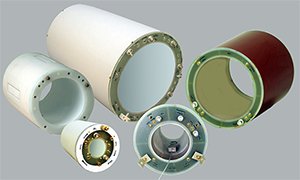

Shown
with CP Litzcage rf coil (removable rf shield not shown.) All
standard sizes
available to 500 MHz. Standard Coil Sizes-
25 mm, 38 mm, 50 mm, 63 mm diameter.
Mouse
Embryo Imaged
at 7T on a Doty Small Animal Imaging Platform with
a CP Litzcage coil
ID=25 mm Length=22 mm
Courtesy of: Youssef
Zaim Wadghiri, Amanda Schneider,
Emily N. Gray, Orlando Aristizabal,
Daniel H. Turnbull and David Gutstein New York University
Versatile,
Open, Robust, Economical Design
The
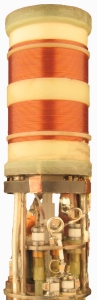
CP litzcage is semi-open and mounted on an almost transparent, short
coil form. The separate, removable, rf shield allows for full, convenient
access to the coil area. The
platform is usually supplied with a CP Litzcage
rf coil with SNR typically 15% higher than that of conventional CP
birdcages of similar dimensions. B1 homogeneity is typically
10-30% better, and the coil has superior B0 homogeneity.
A
unique symmetrizing circuit ensures the coil is easily tuned
and matched to the full range of samples with negligible loss
in efficiency,
channel separation, or symmetry. Tuning range is an order of magnitude
greater than with conventional birdcages and tuning methods.
Other
Coils Also Available
Single-tuned
and double–tuned Litz coils
can be used with the platform but they are less “open” than the Litzcage. The Litz coil
is mounted on an opaque substrate whereas the Litzcage is mounted
on a semi-transparent form. The extra length of the Litz coil
also makes access more limited.
Preprint
available– RF
Coil Technology for Small-Animal MRI. Download
a preprint of “RF Coil Technology for Small-Animal MRI”,
by F. David Doty, George Entzminger, Jatin Kulkarni, Kranti Pamarthy
and John P. Staab, published in [NMR Biomed. 2007; 20: 304-325,
published online in Wiley Interscience, at www.interscience.wiley.com,
DOI: 10.1002/nbm.1149].
To
determine what coil you may want, reference the specification
tables at the
bottom of this page. You may also want to refer to the article What
coil length do you want?
This
T2-weighted rat-brain image was acquired using
a 38 mm Litzcage (on a Doty Small Animal Imaging Platform),
at 200 MHz, while the animal was being concurrently monitored
with scalp EEG after a neuro-surgical procedure. Image courtesy
of: Dr. Joel Garbow and Dr. John Zempel, Wash-ington Univ.,
St. Louis, Missouri, USA.
An
adjustable headholder is available for 38 mm coils. The
headholder shown above is equipped with an adjustable toothbar
and variable depth ear pins (which gently insert into the
ear canals). Adjustments are simple - yet the result is
gentle, secure immobilization of the head. Finally, the
nose cup can be slid over the nose and attached to the
anesthesia line.