
Low Decoupler Heating Using Low E-Field Coils.
A Long Tradition at Doty Scientific... since 1997.

Lowest decoupler heating
using Doty's two coil approach.

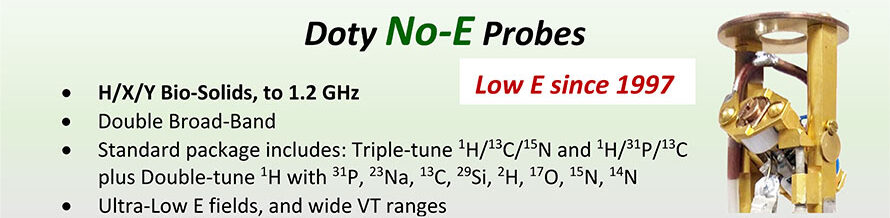
The inner cross coil introduced in 1997 had 110 kHz decoupling fields at 750 MHz with 6 to 25 times lower sample heating compared to solenoid-only probes. Stable tuning, low heating, high sensitivity, and excellent B1 matching on both coils, even for lossy samples. Unlike many other sample coil designs, the B1 homogeneity of the Doty cross-coils is not significantly affected by the sample because of its inherent electrical balance (low E-fields), symmetry, and very low inductance.

What is a cross coil?
The cross coil is a “saddle-type” coil that has an inner one-turn loop in parallel with a segmented turn on each side.
Why use two coils?
Using two orthogonal coils simplifies tuning and permits higher RF fields in larger samples and at very high B0.
How does this help ?
The low inductance cross coil contributes much less to sample heating during decoupling.

Decouple Heating
Doty two coil approach...

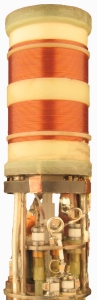
The DE (Doty Entzminger) coil with
an inner solenoid on a BMAXXY probe.

The inner solenoid provides the Highest sensitivity on X and Y. The low E fields DE coil provides low decoupler heating.

The inner cross coil of the PROTONMAX Probe.

1997

Highest decoupling efficiency, with inner the PROTON coil

Longest acquisition times with full decoupling, 150-300 ms


Using two orthogonal coils simplifies tuning and permits higher rf fields in larger samples at very high B0.


In 1997 Doty Scientific introduced a new MAS probe that used a low inductance 1H cross coil with low electric fields, and very low decoupler heating. It was called the "XC" (for cross coil) and was unveiled at at the 38th ENC in Orlando Florida, March 23-27 ,1997. With all the disscussion about low-E coils in the last few years, some of you may be surprised to learn that the Doty PROTONMAX cross-coil probes have been delivered with reliable low-E field coils since 1997, and now our BMAXXY probes, are being delivered with reliable low-E field coils. And the Doty CryoMAS probe will feature low inductance, low-E 1H coils.

Below you can link to a brief record of Doty's low-E Cross Coils.

Download: One of the Doty cros-coil probe patents - Patent # US 6320,384B: "Thermal Buffering of Cross Coils in High power NMR Decoupling"
Provisional application (priority date) December 23, 1996,
Filing date December 19, 1997.

Download: a pdf of the technical poster presented at ENC, 2004 and ISMAR, 2004
"Reducing Decoupler Heating by an order of magnitude in Triple-Resonance
MAS NMR Probes at 750 MHz
"

Download: the original pre-print of our paper Using a Cross-coil to Reduce RF Heating by an Order of Magnitude in Triple-resonance Multinuclear MAS at High Fields”, by F. David Doty, Jatin Kulkarni, Christopher Turner, George Entzminger, and Anthony Bielecki, J. Magn. Reson., 2006, 182, 239-253.