
|
|
|
Doty
OptiMAS™ for Narrow Bore
· Auto Sample Eject with Drop-In Rotors
· Option: Cold-zone cooled for increased sensitivity
OptiMASTM Probe
Spinning Options - New list below:
|
Max. Spinning
Speed
|
02/27/08. New Spinning
Option!!
DI3 (Drop-In
3 mm) Spinner with Auto Sample Eject |
28 kHz
|
| DI4 (Drop-In
4 mm) Spinner with Auto Sample Eject |
18 kHz
|
Spinning with XC4 Spinner
Note: XC4 is not compatible with Auto Sample
Eject or Magic Angle Gradient
|
24 kHz
|
OptiMAS Auto
Sample Eject |
|
Enlarged section
showing rotor capture
|
55%
Gain in S/N with Cooling in OptiMASTM
and
High Resolution:
OptiMASTM probe
with DI-4 spinner and low noise (or cooled) preamps. Cooling the
low-frequency and mid-frequency high voltage plug-in capacitors to
100 K with nitrogen provides major improvement in signal to noise
ratio. “Cold Zone” cooling contributed 42% while cooled
preamps contributed 13% to the 55% gain in S/N. |
Figures
below: OptiMASTM Probe Glycine CP/MAS Spectra
70 kHz decoupling, 1H at 300 MHz
(the sample was not all α-glycine)
|
Figure
A: " Cold zone" at
RT, System Noise Figure =1.1 dB. |

|
Figure
B:
"Cold zone" at -179 C
System NF =1.1 dB. |
|
Figure
C:
"Cold zone" at
-180 C
With Cooled Preamps
System NF =0.7 dB.
|
|
High Resolution |
 |
OptiMASTM
With Magic Angle Gradient Coil
Below: 1H Resolution Spectrum at 300 MHz
Water Spectrum FWHM=0.6 Hz, 8 Scans
|
These
important capabilities found in our other MAS probes,
are also in the new OptiMAS™.
Triple-resonance,
Double-broadband Tuning
|
|
Doty
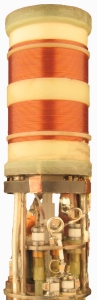
MAS Two-coil Method:
1H
Cross Coil, X/Y Solenoid Coil
What
is a cross coil
?
The
cross coil is a “saddle-type” coil that has an inner one-turn
loop in parallel with a segmented turn on each side.
Why
use two coils
?
Using
two orthogonal coils simplifies tuning and permits higher RF fields
in larger samples and very high B0.
How
does this help ?
The
low inductance cross coil contributes much less to sample
heating
during decoupling. Compared to a solenoid, it’s a factor of
6-25 times less !! |
Lowest
Decoupler Heating
120
kHz decoupling fields at 750 MHz with 6-25 times lower sample heating
compared to solenoid-only probes. Stable tuning, low heating,
high sensitivity, and excellent B1 matching on both
coils, even for lossy samples. Unlike many sample coil designs,
the B1
homogeneity of the XC coil is not significantly affected by the sample
because of its inherent electrical balance, symmetry, and very low
inductance. See our page on "Using
a Cross-coil to Reduce RF Heating.....".
For
more information, please see
our
recent poster on "Maximum
S/N in Narrow-Bore Solids - The OptiMAS™ ,
ENC 2006, Asilomar, CA,
USA.
Please
contact sales
with questions or quote requests.
|